
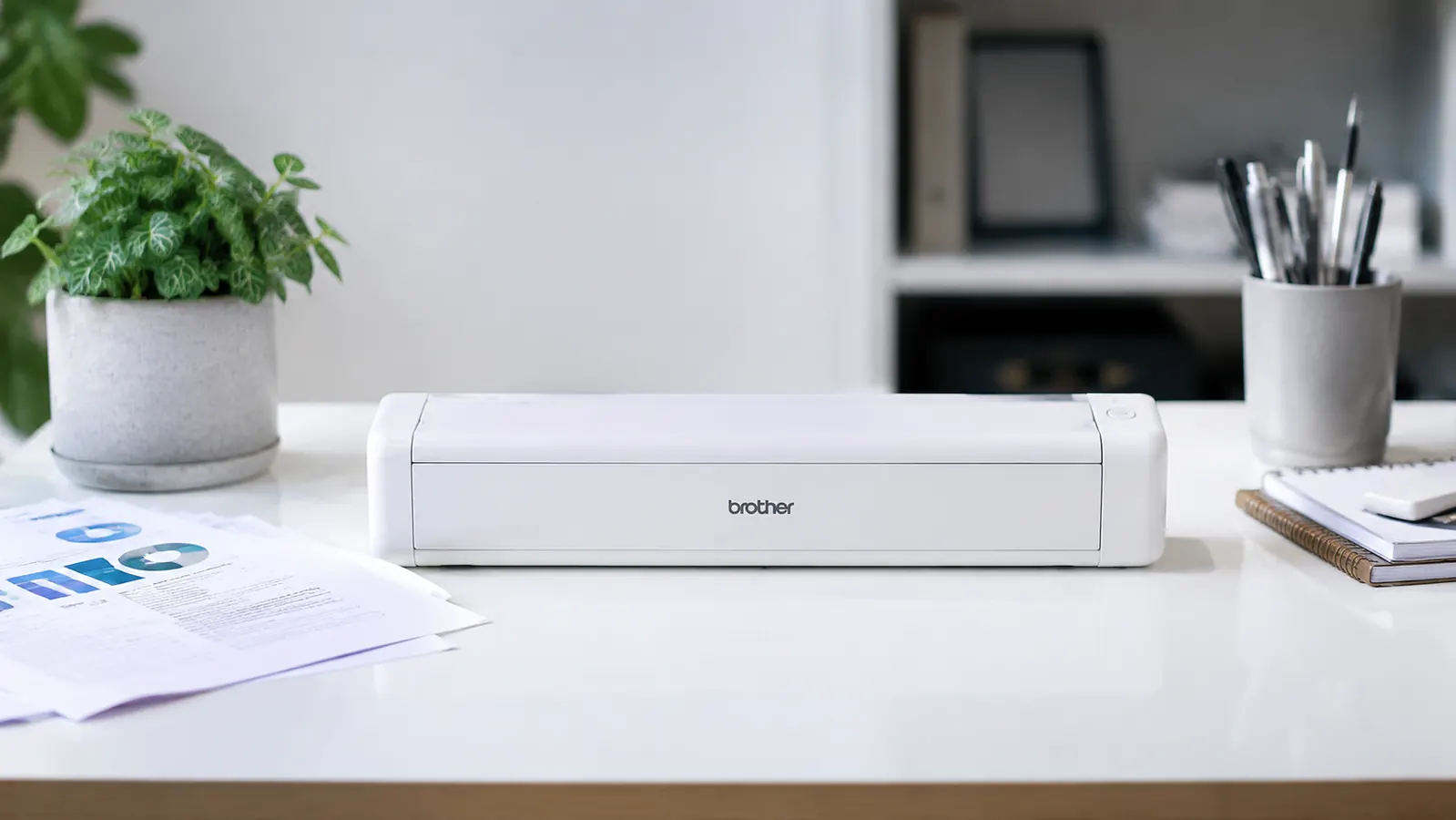
Let me tell you what happens when you search for scanner reviews. You get two kinds of content: press-release rewrites that copy the spec sheet and add stock photography, and Amazon review roundups written by people who have never opened the box. Neither one tells you what it is actually like to use a Brother DS-740D in a working business. I have been using this scanner to process contracts, expense receipts, tax filings, and vendor agreements for my business, and I want to give you the real picture before you spend your money.
The Brother DS-740D (ASIN B083R3XYQN) is a compact duplex mobile document scanner with a 4.3-star rating across 2,353 Amazon reviews. It scans both sides of a document in a single pass, weighs 1.6 pounds, and runs off USB power. At the current price it sits in a competitive spot between cheap single-sided scanners and heavier desktop units. Here is exactly what you need to know before buying, including the parts most reviewers gloss over.
The Quick Verdict
The DS-740D does its core job as well as anything in its category: duplex scanning at legitimate speed, in a package small enough to throw in any bag. The bundled software is forgettable, USB-only is a real constraint, and bulk batch jobs above 25 pages will slow you down. For a solo operator or small team who scans steadily but not heavily, this is the right tool.
Amazon Check Today's Price →If you are still scanning one page at a time on a flatbed, you are trading real working hours for a $170 problem.
The Brother DS-740D does duplex in one pass, fits in your laptop bag, and installs in under 15 minutes. Check the current price before you decide.
Amazon Check Today's Price on Amazon →What Nobody Tells You: The Real Setup Experience
Most scanner reviews say 'easy setup' and move on. Here is the actual experience. You download the driver from Brother's support page, run the installer, plug in the USB cable when prompted, and the scanner is recognized within about 30 seconds. On a clean Windows 11 machine the full process runs about 12 minutes. On a Mac running recent versions of macOS the scanner is detected natively for basic functions, though you still want the full Brother driver package for resolution and format control. If you have had bad experiences with scanner drivers on older Windows machines, this is genuinely one of the better implementations I have seen from any peripheral brand.
The one thing that trips people up: the bundled iPrint and Scan software is functional but it looks like something designed in 2014. If you launch it and feel disappointed, that is the correct reaction. The software does scan-to-PDF and scan-to-folder without any complexity, which is enough for most business use cases. But the moment you want to control output compression, auto-straighten pages, or integrate directly with cloud storage, you will want to drop in a third-party scanning app. VueScan, PaperScan, and Adobe Acrobat all work cleanly with the DS-740D driver. Budget about 20 minutes on day one to get your preferred tool configured.
Duplex Speed: The Number That Actually Matters, and Whether It Is Real
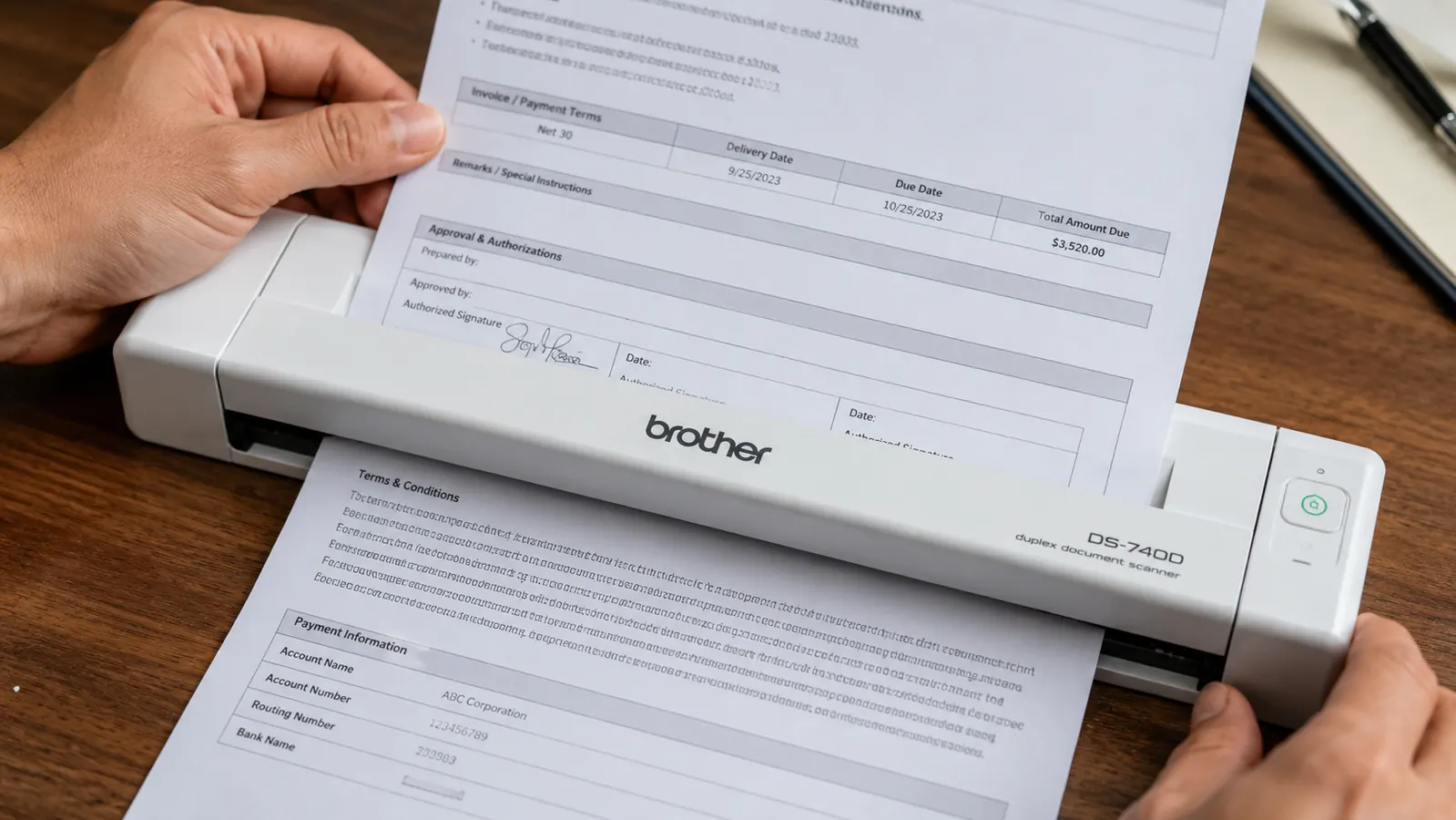
Brother rates the DS-740D at 16 pages per minute in duplex mode. That is 16 physical pages per minute, meaning 8 two-sided sheets per minute, capturing front and back in a single mechanical pass. In practice the number holds up. A 10-page two-sided contract (20 page faces) finishes in roughly 75 to 80 seconds at 300 dpi. The bottleneck is how fast you can hand-feed pages into the slot, not the scan mechanism itself.
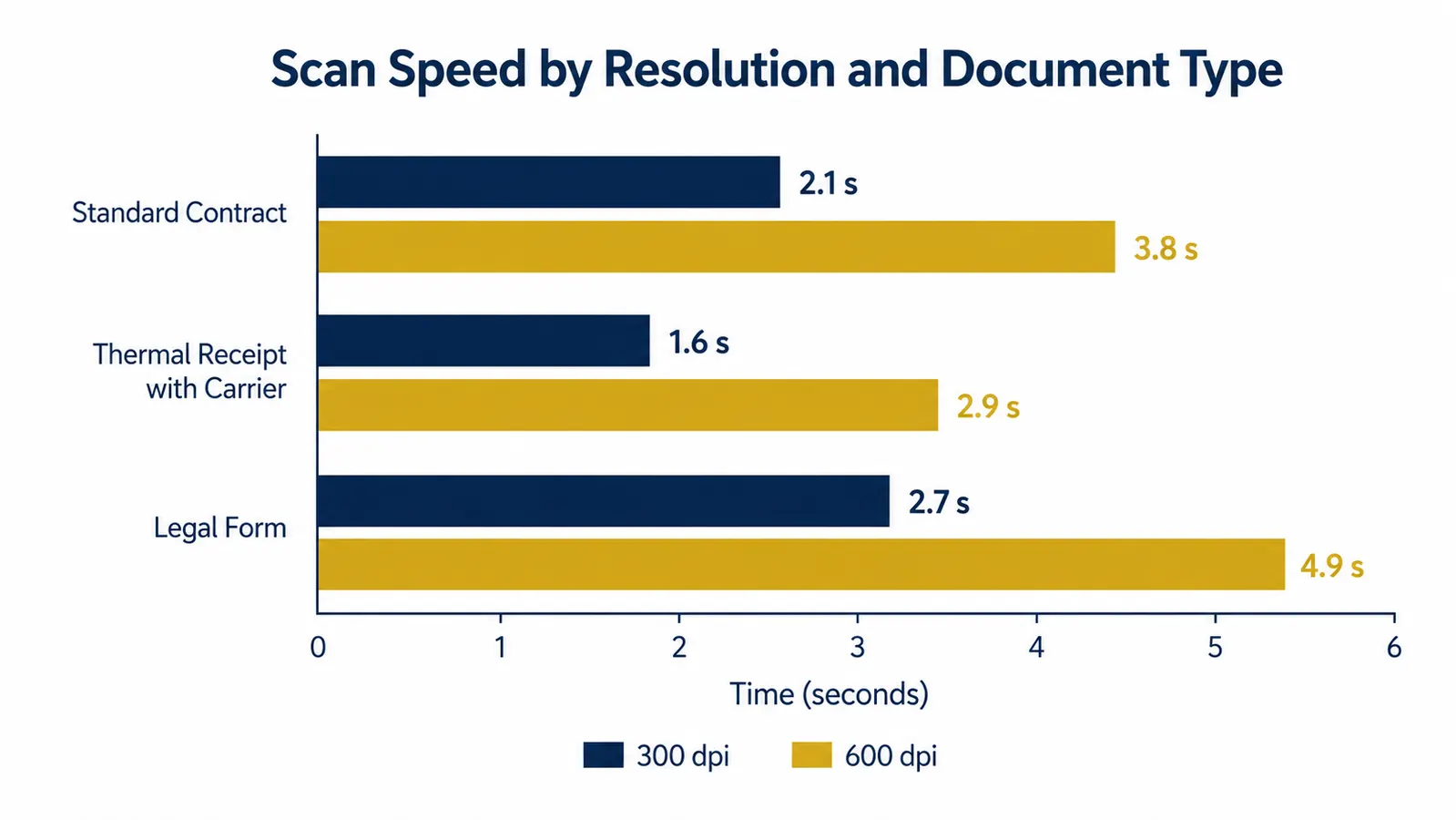
Here is the thing most reviewers do not explain: duplex speed at 300 dpi and duplex speed at 600 dpi are not the same. At 600 dpi the scanner slows down noticeably because the data per page roughly quadruples. For business documents, typed text, printed forms, and signed contracts, 300 dpi produces a clean, legible, archival-quality PDF. I tested 600 dpi on a 15-page legal filing and the quality improvement was visible only under a zoom-in comparison. For standard business scanning, 300 dpi is the right setting and the 16-ppm rating applies.
The image quality at 300 dpi is solid across the range of document types a business owner typically scans: typed text is crisp, printed tables are clean, handwritten signatures are readable, and printed forms with checkboxes scan without artifacts. Where quality dips slightly is on low-contrast thermal receipts that have already faded. Those scan at around 80 percent readability for the faded text, which is usually still adequate for expense records. Fresh thermal receipts scan cleanly.
The USB-Only Limitation: Is It Actually a Problem
The DS-740D connects to a computer exclusively via USB. There is no Wi-Fi, no Bluetooth, and no mobile app that scans directly to your phone. If your workflow assumes a wireless scanner or shared network access, this is not the right product. Full stop.
For most solo business owners, the USB-only design is not a real problem. You scan at your desk with your laptop open. Plugging in a USB cable takes three seconds. The scanner is powered by the same USB connection, so there is no wall adapter to hunt for unless you specifically want one for stationary desk use. Where the limitation surfaces is when a team of two or more people all need to scan documents without scheduling time at the one computer that has the scanner plugged in. If that describes your operation, look at a network-capable scanner or a multifunction device with wireless capability.
The other USB-related issue worth flagging: the cable included in the box is USB-A to USB-B micro. If your laptop has only USB-C ports, which is common on current MacBooks and many Windows ultrabooks, you will need a USB-C adapter or hub. Brother does not include one. This is a $10 fix but it is annoying to discover after unboxing. Add it to your order if your machine is USB-C only.
The bundled software will disappoint you. That is okay. The driver underneath it is excellent, and every serious scanning app you already use will work with it perfectly.
Paper Feed and Edge Cases: What Actually Causes Problems
Standard 20-pound copy paper, legal forms, and most printed contracts feed without any intervention. The mechanism is consistent and I have had no misfeeds on normal paper stock. Where you will run into issues is with non-standard media, and the DS-740D handles this the honest way: it includes a carrier sheet in the box, and you need to use it for small or thin media.
Thermal receipts narrower than about 3.5 inches will skew on the feed if you put them in unprotected. Tape them to a piece of standard paper or slide them into the carrier sheet and the problem disappears. Business cards misfeed if you try to run them through directly. The carrier sheet fixes this too. Laminated documents, ID cards, and anything thicker than standard paper stock all need the carrier sheet as well. Once you get into the habit of using it for non-standard items, the frustration goes away. But it is an extra step that some users do not expect.
Batch size is the other honest limit. The DS-740D does not have a stacked automatic document feeder. You load documents one at a time into the feed slot. The scanner continuously pulls them through, so you can load the next sheet while the previous one is finishing, creating a fast manual feed rhythm for stacks of 10 to 20 pages. For anything above 25 to 30 pages, you are hand-feeding for a couple of minutes. It is not burdensome for occasional large jobs. If your daily workflow involves scanning 50-page project files or quarterly reports, a desktop ADF unit will serve you better.

Software Deep Dive: What To Use Instead of iPrint and Scan
I want to spend a moment on software because it is where the DS-740D's story gets a little more complicated. Brother's included iPrint and Scan application works. It scans pages to PDF or JPEG, lets you set basic resolution, and saves to a folder of your choice. The interface is dated and does not integrate with Google Drive, Dropbox, or any cloud service natively. You scan to a local folder and then move the file yourself.
The upgrade path is straightforward. If you use Adobe Acrobat as part of your business workflow, it recognizes the DS-740D driver and you can scan directly into a PDF within Acrobat with full control over compression and page size. If you prefer a standalone scanning tool, VueScan ($35 for a personal license) gives you professional-grade controls: output compression, color management, deskew, multi-page PDF assembly, and direct save to any cloud-synced folder. For a business that processes documents daily, VueScan or equivalent is worth the extra spend.
One feature worth knowing about: the DS-740D is compatible with Brother's iPrint and Scan app on both Windows and Mac, and it also works as a TWAIN and WIA device, meaning any scanning software that supports those standards, which is essentially all of them, will see it. You are not locked into Brother's ecosystem. That is important to know if you are evaluating this against a scanner from a brand that forces proprietary software.
What I Liked
- Duplex scanning at 16 pages per minute is genuine: both sides captured in one pass, not two
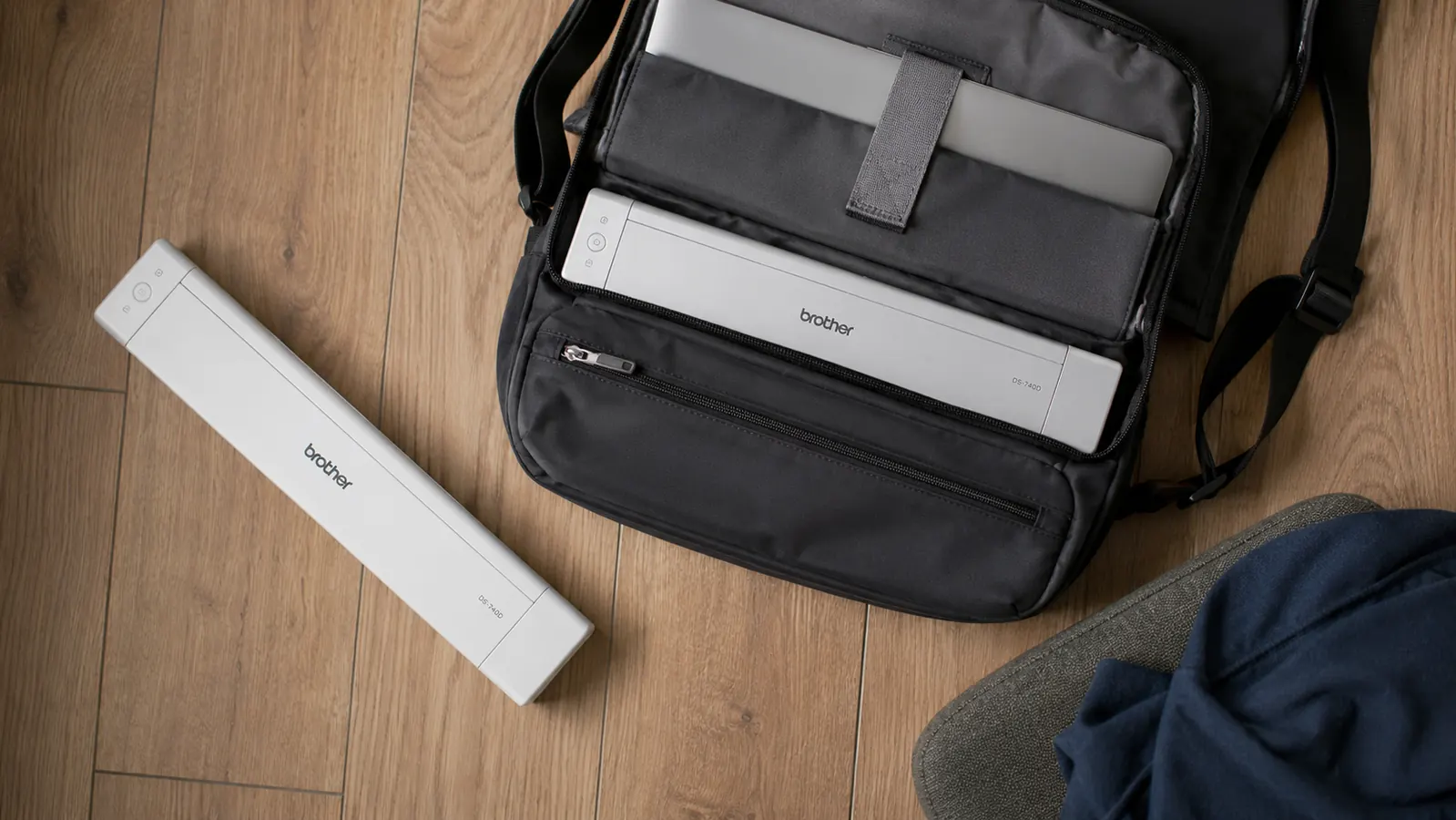
- Compact 1.6-pound form factor fits in any laptop bag for field scanning at client meetings or off-site work
- Excellent driver stability on Windows 11 and current macOS versions, works as a TWAIN/WIA device with any scanning software
- Included carrier sheet handles thermal receipts, business cards, and non-standard media cleanly once you build the habit
- Legal-size support built in with no configuration changes required
- USB-powered so no separate wall adapter is needed for mobile use
Where It Falls Short
- USB-only connectivity with no Wi-Fi or Bluetooth option limits sharing in multi-person offices
- Bundled iPrint and Scan software is dated and lacks cloud integration; most users will need a third-party app
- USB cable is USB-A to USB-B micro; USB-C laptop users need an adapter not included in the box
- Manual page-by-page feed limits practical batch size to 25 to 30 pages at a time
- Thermal receipts and non-standard media require the carrier sheet, adding a step to receipt scanning
- AC wall adapter for stationary desk use is sold separately
How the DS-740D Compares to What Else Is Out There
At the current price the DS-740D competes primarily with the Epson WorkForce ES-400 and the Fujitsu ScanSnap iX100. The Epson is faster on large batch jobs and has a real ADF tray that holds sheets without manual feeding, but it is physically larger, heavier, and closer to twice the price. If you process more than 40 pages in a single sitting regularly, the Epson is the right answer. If you do not, you are paying a premium for capacity you will never use.
The Fujitsu ScanSnap iX100 is the DS-740D's most direct competitor in size and use case. It is wireless, which matters if you want to scan directly from a mobile workflow. It costs more and does not do duplex natively. For a business owner who is always at a laptop when scanning, that wireless capability is not worth the price difference. If you genuinely need to scan at a desk without a computer present, the iX100 is worth the premium. For most business users, the DS-740D wins that comparison on value. I covered the full head-to-head against the Epson in the Brother DS-740D vs Epson WorkForce ES-400 comparison.
Who This Is For
The Brother DS-740D is the right scanner for a solo business owner, consultant, freelancer, or small-team operator who generates a steady flow of two-sided business documents and needs reliable, fast digitization without a copier-sized machine. You sign contracts, you receive vendor invoices, you keep receipts for tax purposes, and you want all of that in a searchable folder structure without paper clutter. If that is you, the DS-740D will do exactly that job every single day without drama.
It is also the right answer for anyone who works out of multiple locations. A consultant who splits time between a home office and a client site, a real estate agent who closes deals on location and needs to scan amendments the same day, or a field-service operator who logs paper records at a remote site will find this the most practical scanning option available. The 1.6-pound weight and bag-compatible size are meaningful advantages that a desktop scanner cannot replicate. For more context on building a paperless document system from scratch, the long-term use piece on going paperless in a small business covers the full workflow in detail.
Who Should Skip It
If your office has three or more people submitting documents for centralized scanning, a networked or wireless scanner on a shared workstation will serve you better. The DS-740D's USB-only design means one computer, one user at a time, no exceptions. If you regularly scan documents longer than 30 pages in a single batch, the manual feed rhythm will wear on you and a desktop ADF machine is worth the investment. If you want to scan directly from a smartphone without opening a laptop, this scanner cannot do it. And if you are deeply embedded in a specific scanning ecosystem like ScanSnap's cloud integrations, the Brother driver will work but you will lose that native integration.
For everyone else, the objections to the DS-740D are mostly theoretical. The USB-only limitation does not sting if you always have a laptop open. The manual feed is a non-issue if your daily scan volume is under 30 pages. The bundled software limitation disappears the moment you drop in a better app. What remains is a fast, reliable, compact duplex scanner that earns its space on any working desk.
You already know a document scanner would clean up your workflow. The question is whether you want to keep putting it off.
The Brother DS-740D duplex mobile scanner is compact, fast, and driver-stable on both Windows and Mac. Check today's price on Amazon and see if it fits your setup.
Amazon Check Today's Price on Amazon →