
If you are building a business and you need to block out noise on calls, in open offices, or at home with kids in the background, you have probably landed on two names: the Sony WH-1000XM5 and the Bose QuietComfort Ultra. Both are over $250. Both claim best-in-class noise cancellation. Both have enough online reviews to fill a spreadsheet. So which one do you actually buy? The short answer is the Sony WH-1000XM5, and the gap is wider than the marketing suggests.
I am not writing this to split hairs on audiophile specs most of us will never notice. I am writing it for the founder who needs to make one decision, buy the right tool, and get back to the work that pays the bills. Here is what actually matters.
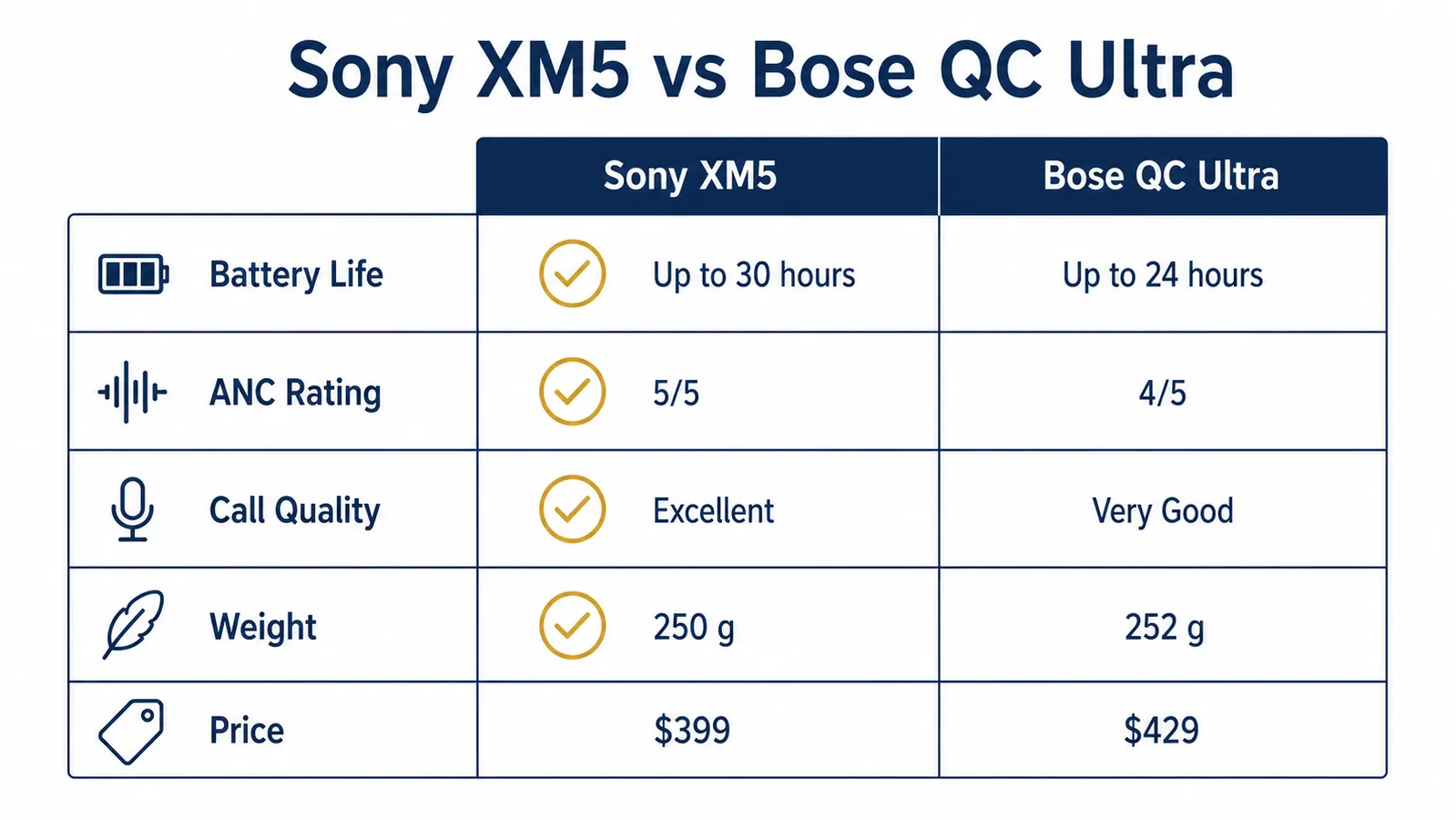
| Sony WH-1000XM5 | Bose QuietComfort Ultra | |
|---|---|---|
| Battery Life | 30 hours (ANC on) | 24 hours (ANC on) |
| Active Noise Cancellation | Industry-leading Auto NC Optimizer | CustomTune technology, very strong |
| Call Quality (mic) | 8-mic system, beamforming AI noise reduction | 4-mic system, Bose WindBlock |
| Weight | 250 g | 254 g |
| Multipoint Bluetooth | Yes (2 devices simultaneously) | Yes (2 devices simultaneously) |
| Foldability | Does not fold flat | Folds flat into case |
| Speak-to-Chat | Yes, auto-pauses when you talk | No equivalent feature |
| Codec Support | LDAC, AAC, SBC | AAC, SBC (no LDAC) |
| Street Price | Around $278 | Around $329 |
Stop losing two hours a day to open-office noise. The XM5 fixes that.
The Sony WH-1000XM5 is the most-reviewed premium noise-cancelling headphone in its class, rated 4.2 stars across more than 19,000 purchases. Check today's price on Amazon and see if it is in stock.
Amazon Check Today's Price on Amazon →
Where the Sony WH-1000XM5 Wins
The XM5's Auto NC Optimizer is the feature that actually separates these two headphones in real business use. Every time you put the Sony on, it runs a quick calibration based on your ear shape and the ambient noise around you. The result is noise cancellation that adjusts to your environment in real time rather than applying a fixed profile. If you move from a quiet office to a noisy airport terminal to a crowded coffee shop in the same afternoon, the XM5 adapts. The Bose QC Ultra's CustomTune does something similar on ear-on, but lacks the continuous adjustment in dynamic environments. For people who work in more than one location, that difference is real and consistent.
The second win is the microphone system for calls. The XM5 runs eight microphones with AI-driven beamforming that filters out background noise before it ever reaches the other person on your call. If you are closing deals on the phone from a coffee shop or running team standups from a home office with construction outside, the XM5 keeps your voice cleaner than the Bose. The QC Ultra uses four mics with Bose WindBlock, which handles wind outdoors well but does not isolate speech in reverberant indoor environments as cleanly. For the entrepreneur who lives on calls, this is not a minor point. It is the point.
Battery life is the third leg. The XM5 gives you 30 hours with ANC running. The Bose QC Ultra gives you 24. Over a full travel week, that six-hour gap means the Sony makes it through the trip without a charge, and the Bose often does not. Quick-charge helps, but having to find an outlet during a layover is friction you do not need.
Where the Bose QuietComfort Ultra Wins
The Bose QC Ultra does two things better than the Sony. First, the ear cups fold flat. If you pack light and throw headphones into a laptop bag alongside a charger, cables, and a notebook, the QC Ultra fits more compactly. The XM5 comes with a carrying case but the cups pivot rather than fold flat, so the case is bulkier. This matters more for frequent travelers than for people who park headphones on a desk hook between sessions.
Second, the Bose QC Ultra has an Immersive Audio mode that creates a spatial sound experience for music and movies. If you are a founder who also uses headphones heavily for content consumption or creative work where soundstage matters, the Bose sounds more three-dimensional. The Sony's audio profile is accurate and detailed, but it does not attempt spatial audio in the same way. This is genuinely a preference call for the user who cares, but for most business buyers it is not a factor that justifies paying an extra $50.
The Sony WH-1000XM5 beats the Bose QuietComfort Ultra on the three things founders actually care about: noise cancellation depth, call mic quality, and battery life. Everything else is secondary.

Who Should Buy Which
Buy the Sony WH-1000XM5 if you spend significant time on calls, work across multiple noise environments in a day, want the longest battery run time between charges, or prefer paying less for a better core tool. At around $278 versus $329 for the Bose, the Sony costs less and outperforms on the specifications that drive daily productivity. It is the pragmatic choice for almost every founder and professional.
Buy the Bose QuietComfort Ultra if portability for travel is your single highest priority, you want a headphone that folds flat into the smallest possible case, or you genuinely care about spatial audio for media consumption and are willing to pay a premium for that feature. These are legitimate reasons to go Bose. They are just not the reasons most business buyers should be optimizing for.
There is also a third group: people who already own a Bose and are wondering whether to switch. If your QC Ultra or older QC45 still functions, there is no emergency. The Sony is better by a meaningful margin on calls and ANC, but you are not leaving money on the table by running your current headphones until they fail. When they do, buy the Sony. If you are buying for the first time, skip the deliberation.
One note on the Speak-to-Chat feature on the Sony: it is small but genuinely useful. When someone walks into your office and says something to you, the XM5 detects that you are speaking and automatically pauses your audio without you touching a button. It resumes on its own after a few seconds of silence. The Bose has no equivalent. Over a full work week, this small friction reduction adds up.
Both headphones support Bluetooth multipoint, so you can stay connected to your laptop and phone simultaneously without re-pairing when a call comes in. Both have strong app ecosystems for EQ and ANC control. Both have a years-long track record of build quality. These are not corners either company has cut. The decision lives in the specifics above, not in reliability.
For founders who have already read the detailed long-term review of the Sony WH-1000XM5, you know how it holds up across six months of daily use. You can also read the honest review that covers the real drawbacks before you buy. The comparison above is meant to close the loop for anyone stuck between these two specific models.
The Sony WH-1000XM5 is the better tool for serious work. Here is today's price.
With 30-hour battery, eight-mic call clarity, and adaptive noise cancellation that responds to your environment, the WH-1000XM5 is the one we'd buy. Check current availability and pricing on Amazon.
Amazon Check Today's Price on Amazon →