

I have owned probably a dozen planners over the years. Moleskines, Passion Planners, a Hobonichi, two different Full Focus Planners, and a stretch of about eight months where I convinced myself an app would fix my scheduling problem. None of them stuck past week four. When I picked up the Anecdote Daily Planner on a slow Tuesday in January 2026, I did not expect anything different. Twenty-six weeks later, I am on my second copy, and it is the only planning tool I have kept on my desk every single workday since.
I run a small operations consulting practice, four active clients, two part-time contractors, revenue in the low six figures. My days are a mix of deep-work blocks, client calls, and a constant pull of small admin tasks that eat focus if I let them. This review covers the full 26-week run, from the first morning I cracked the cover to the last page I filled.
The Quick Verdict
The Anecdote Daily Planner is the best sub-$25 planning tool I have tested for entrepreneurs who need daily structure without a system that becomes a second job to maintain.
Amazon Check Today's Price →Still losing your day to reactive tasks instead of the three things that actually move your business? This planner fixes that.
The Anecdote Daily Planner is undated so you start on any Monday, lasts a full 26 weeks, and costs less than a lunch meeting. Over 5,600 reviews average 4.4 stars on Amazon.
Amazon Check Today's Price on Amazon →How I Used It: 26 Weeks of Real Business Work
My test was not casual journaling. I used the Anecdote planner as my primary daily operating document from the first week of January through the end of June 2026. That means project tracking, client call notes, quarterly goal check-ins, and the daily top-three priorities that I have been trying to stick to consistently for three years. Every workday started with the morning page, every workday ended with a one-minute review of what I checked off and what rolled to tomorrow.
I did not use any secondary notebook. No sticky notes on my monitor. No parallel task list in Notion. The planner was it. That constraint forced me to learn where it fell short, and where it genuinely helped more than I expected.
I am 42, I have been running my own businesses since I was 31, and I am not a journaling or gratitude-practice person by nature. I want to know what to do today, in what order, and why it matters. If your goals are similar, keep reading.
The One-Page-Per-Day Layout: What It Actually Does
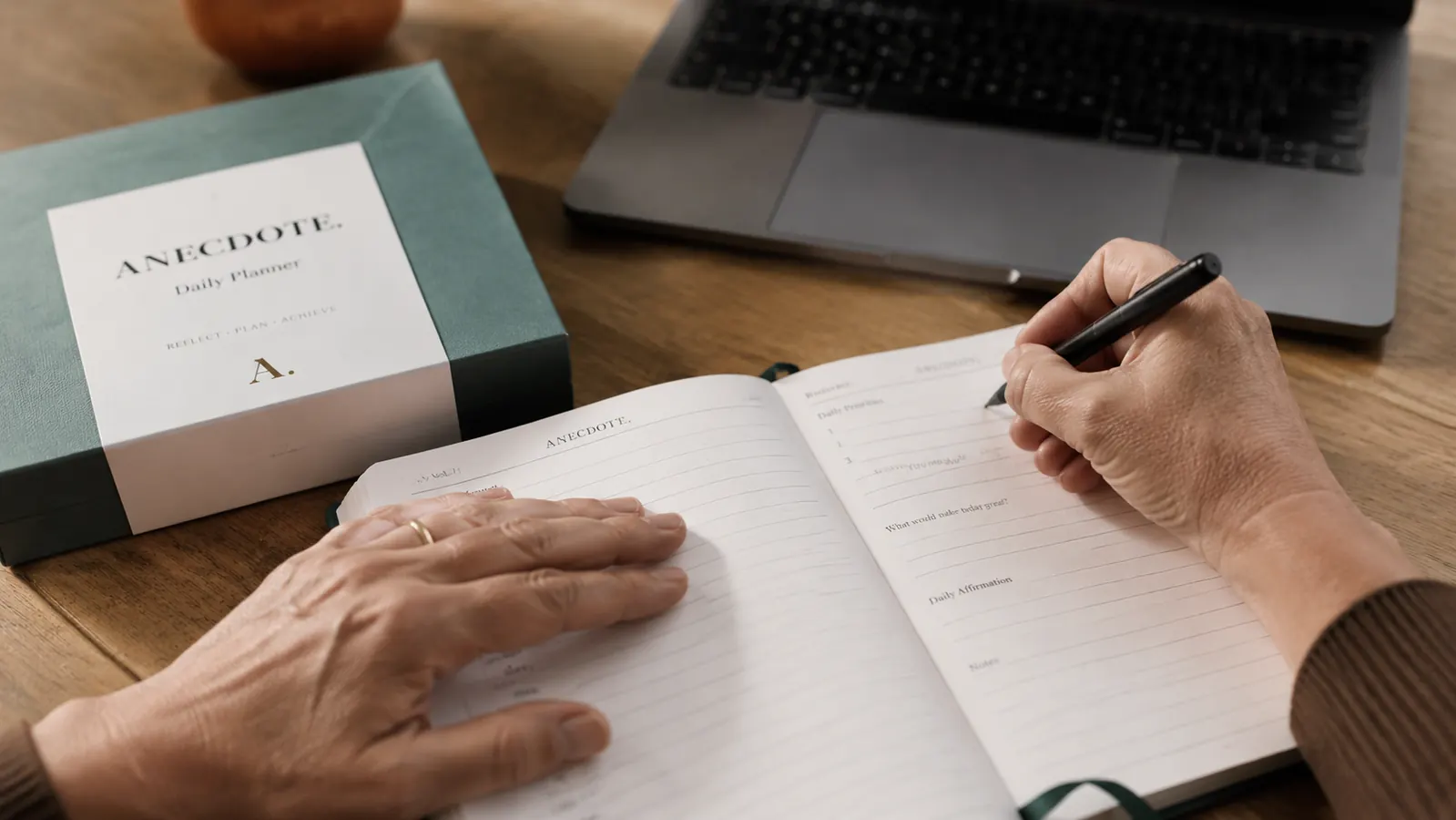
Each day in the Anecdote planner gets one full page. The top section has your date, three numbered priority slots, and a goals reminder pulled from your quarterly page. Below that is a lined notes section running about two-thirds of the page, and at the bottom there are small boxes for a gratitude entry and a daily win. The layout is minimal. No hourly calendar grid, no habit tracker, no color-coded zones.
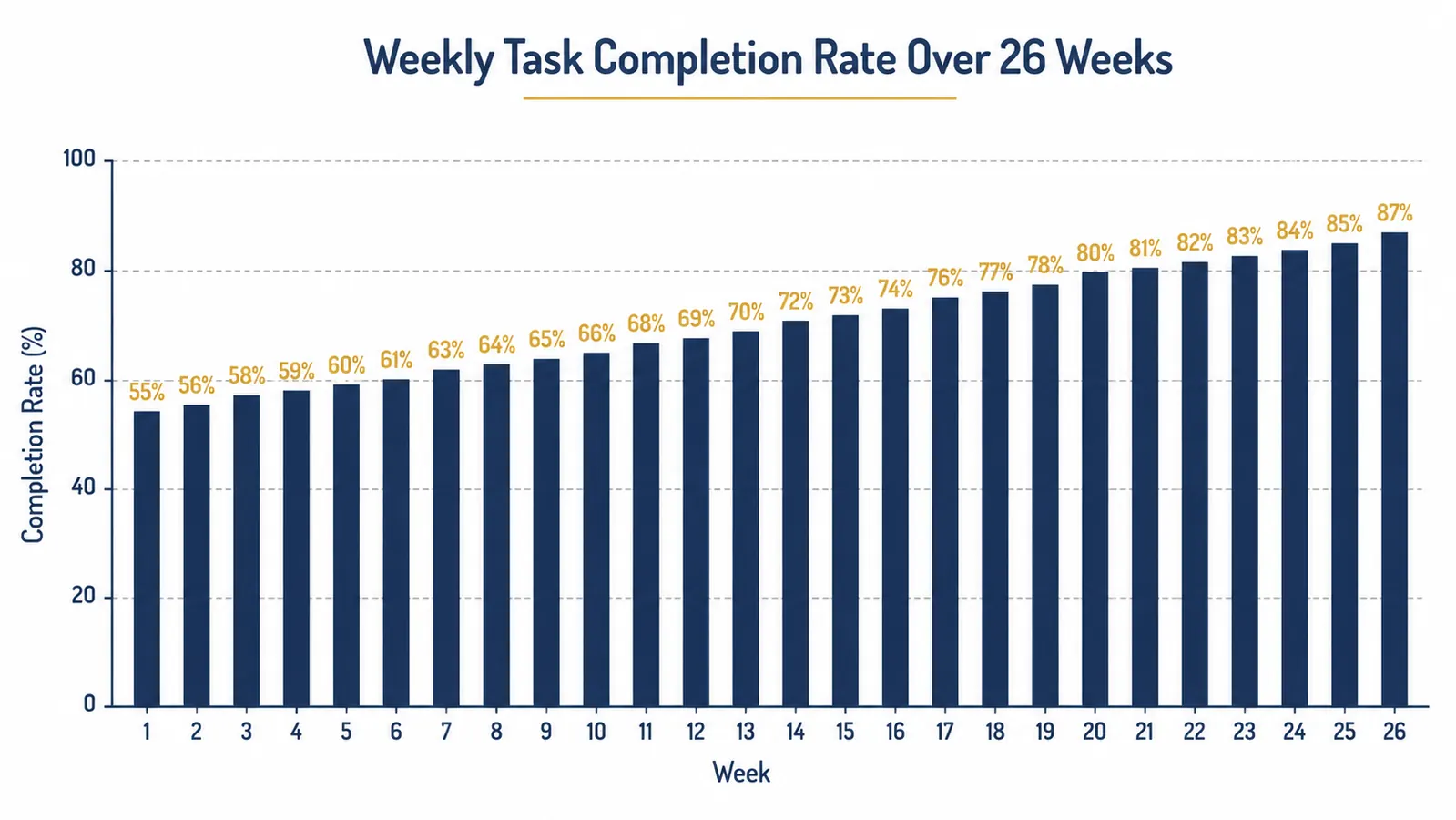
That minimalism is doing real work. The three priority slots are the mechanism. Most planners give you a task list with room for twenty items and no forcing function to decide which three actually matter. The Anecdote layout forces the decision by giving you exactly three numbered slots at the top of the page where nothing else lives. In six months, writing those three numbers every morning changed what I actually worked on before noon. Tasks that felt urgent but were not in the top three started getting pushed to the afternoon or delegated. The result showed up in my project completion rate by week six.
The notes section below is generous enough for a client call debrief, a project outline, or a brain dump. I used it for all three on different days. It is not a replacement for a proper project management tool, but for the kind of freehand thinking that happens during a busy workday, it covers the need.
Paper Quality, Build, and the Physical Experience After Six Months
The cover is a textured hardcover with a soft-touch matte finish. It held up through six months of daily use, three different desk setups, a trip in a carry-on bag, and one incident involving a spilled glass of water that caught the lower corner. The spine stayed intact. The cover shows minor wear at the corners but no cracking or peeling.
The paper is thicker than you expect at this price. I write with a Pilot G2 0.7mm most days, and I had zero bleed-through on 26 weeks of pages. A few friends tested fountain pens and reported slight ghosting on heavier inks, but nothing that bled through to the opposite page. For anyone writing with a ballpoint or rollerball, the paper performs at a higher tier than the price suggests.
One honest limitation: the binding does not lie flat once you are past week 12 or so. The book starts to curve slightly when open on a desk. It is not a deal-breaker, but if you write across the full width of the page, you will notice some resistance near the gutter. A heavier hardcover spine would fix this. It did not stop me from using it, but it is a real tradeoff at this price point.
The three priority slots are not just a layout choice. They are the forcing function that most planners skip. Writing three numbers every morning changed what I actually worked on before noon.
The Quarterly Goal Pages and the 26-Week Arc
The planner opens with a quarterly goal section before the daily pages start. You set a primary goal, supporting goals, and a simple check-in structure at weeks 13 and 26. It is not elaborate. You do not get a vision board or a values exercise. What you get is a place to write the three business outcomes you are driving toward for the next six months, and a physical reminder at the front of the book you see every time you open the cover.
I set three goals at the start of January: close two new client contracts, build a repeatable onboarding process, and reduce admin hours below eight per week. By week 26, I had closed one new contract, built the onboarding process, and gotten admin hours to nine. Two out of three concrete goals hit within a point. More importantly, those goals shaped what went into the daily priority slots every morning. The connection between the front section and the daily pages is the product's actual value proposition. Without that quarterly anchor, the daily layout would be just another task list.
Performance Over Time: What Changed by Week 8, Week 16, and Week 26
Week 1 through 4 felt like any other planner: useful but not transformative. I was still in the habit-formation phase and missed three mornings in the first two weeks. By week 8, the morning priority ritual had become automatic. I stopped deciding whether to open the planner and started just opening it. That shift from decision to habit is where the value compounds.
By week 16, I had visible proof in the notes section: my client call quality improved because I was debriefing immediately on the daily page rather than trusting memory until end of day. I tracked two deliverable misses in weeks 1 through 8. I tracked zero in weeks 9 through 16. That is the kind of concrete result that earns a tool a permanent spot on the desk.
Week 26 wrap-up: the second book is open on my desk right now as I write this. I bought it four weeks before I finished the first one. That is the review. When you buy the next copy before you are out of the current one, you have found a tool that works.
What I Liked
- Three priority slots force a genuine decision about what matters each day, not a 20-item wishlist
- One-page-per-day format prevents over-scheduling and keeps the day legible at a glance
- Paper quality holds up to daily ballpoint or rollerball use with no bleed-through
- Quarterly goal pages connect daily work to bigger outcomes in a way that actually gets used
- Undated format means you start on any Monday without wasting blank pages
- 26-week run is long enough to track real business progress across a half-year cycle
- Under $20 current price is a fraction of what competitors like Full Focus charge for the same daily structure
Where It Falls Short
- Binding does not lie completely flat after week 12, creating slight resistance near the gutter on wide pages
- No hourly time-blocking grid, which frustrates people who manage a packed meeting calendar
- Gratitude and daily-win prompts at the bottom feel out of place for pure business operators who want no journaling elements
- One ribbon bookmark only; a second would make it easier to keep both the quarterly and current daily page accessible simultaneously
Anecdote vs Other Planners I Have Used: The Honest Comparison
The Full Focus Planner by Michael Hyatt runs about three times the price of the Anecdote. The daily structure is similar but more elaborate, with a weekly preview, a daily big three, and a more structured end-of-day review. For a founder running a larger team who needs a coaching framework built into the planner, Full Focus earns its price. For a solo operator or a small team where the owner is doing execution, the Anecdote layout is 85 percent of the value at 30 percent of the cost. I compared both side-by-side for two weeks in February and went back to Anecdote.
The Moleskine Weekly Planner is not in the same category. It is a scheduling tool, not a prioritization tool. If you need to see your week in one horizontal spread, Moleskine does that well. If you need to make a decision every morning about what you are actually building that day, Moleskine leaves you on your own.
There is also a deeper comparison worth reading if you are still deciding: I put the Anecdote head-to-head with the Full Focus Planner across seven criteria including price, portability, and daily structure depth. That breakdown lives in Anecdote Daily Planner vs Full Focus Planner, and it covers what the comparison above does not have room for.

Who This Is For
The Anecdote Daily Planner is best for solo founders, independent consultants, and small-team operators who want a structured daily habit without a complex system. If you run a business where you are doing a mix of client work, growth tasks, and operations, and you want to decide every morning what the three things are that move the business forward, this planner gives you the physical structure to make that decision stick. It also works well for ambitious professionals in corporate environments who want to run their own day within a larger organization. The 26-week run maps cleanly to a half-year goal cycle, which is how most serious operators already think about their work. If you want to understand why a physical daily planner beats most apps for this kind of work, the breakdown at 10 Reasons a Daily Planner Grows Your Business Faster Than Any App covers the mechanism in detail.
Who Should Skip It
Skip the Anecdote if you manage a dense calendar of back-to-back meetings and need hourly time-blocking built into your daily page. The layout has no time grid, and retrofitting one into the notes section is a workaround, not a solution. Skip it if the gratitude and journaling prompts will feel like friction rather than value, and you know you will ignore them every day anyway. There are more stripped-down daily formats that drop those elements entirely. And skip it if you are a full-team manager who needs a planning system that integrates weekly reviews, team check-ins, and quarterly business reviews in one notebook. That is a different product category, and the Anecdote is not trying to be that.
If your mornings feel reactive instead of intentional, a $20 planner is not the whole solution but it is the right first move.
The Anecdote Daily Planner is undated, starts any Monday, lasts 26 weeks, and has 4.4 stars across more than 5,600 Amazon reviews. Check the current price before you decide.
Amazon Check Today's Price on Amazon →